





Products
Product Types
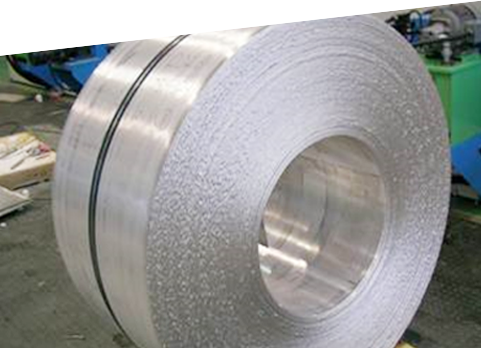
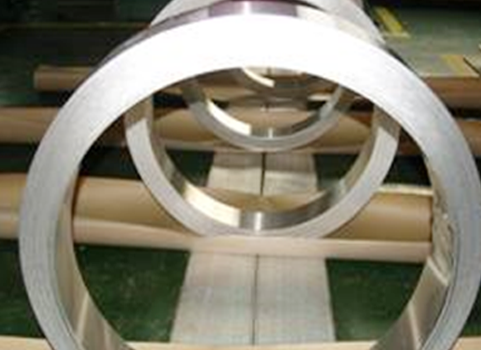
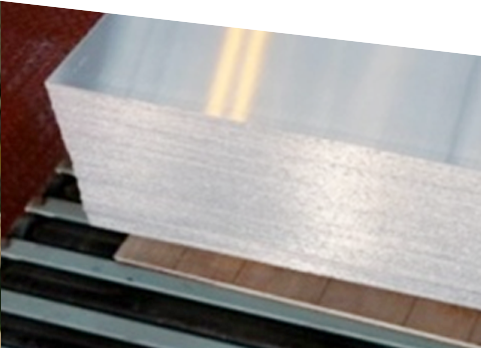
Product specifications
| Type | Thickness | Width |
| Quantum (Narrow Sheet) | 0.3 ~ 4.0 mm (0.012 ~ 0.157 inch) | 350 ~ 550 mm (13.78 ~ 21.65 inch) |
| Magnum (Wide Sheet) | 0.4 ~ 6.0 mm (0.016 ~ 0.236 inch) | 900 ~ 1,800 mm (35.43 ~ 70.87 inch) |
Physical Properties of Alloys
AZ31B (General-Purpose Magnesium Alloy)
As the most widely used standard magnesium alloy, AZ31B boasts an excellent strength-to-weight ratio that facilitates lightweight designs. It features exceptional specific strength and machinability, along with superior vibration damping and electromagnetic shielding capabilities, making it the ideal base material for a wide range of industries.
E-Form Plus (High-Formability Alloy)
Standing for "Easy & Economical Formability," E-Form+ is a next-generation alloy that transcends the forming limitations of conventional magnesium. Unlike standard AZ31B, which requires forming at high temperatures of around 250°C, E-Form+ demonstrates excellent formability even at relatively lower temperatures (150–180°C). With an Erichsen Value of 7–9 mm—more than double that of AZ31B (~3.0 mm)—it minimizes cracking during processing and enables greater design flexibility.
AZ61 (High-Strength Alloy)
Engineered to provide significantly stronger mechanical properties than the general-purpose AZ31B, this alloy is optimized for components requiring enhanced durability.
AZ91 (Ultra High-Strength Alloy)
With a tensile strength of approximately 290 MPa and a yield strength of around 255 MPa, AZ91 delivers superior strength due to its high aluminum content. It serves as a key material for advanced industrial components demanding extreme durability.
Heat Sinker (High Heat-Dissipation Alloy)
With a thermal conductivity of 135 W/m·K, this alloy offers significantly enhanced cooling performance compared to AZ31B (85 W/m·K). Its high electrical conductivity also makes it ideal for high-speed machining and components requiring efficient thermal management.
Posnoble3 (High Corrosion-Resistance Alloy)
Posnoble3 features corrosion resistance more than 10 times greater than AZ31B, ensuring material stability even in highly humid or saline environments.
AXM410 (Flame-Retardant & High-Rigidity Alloy)
This innovative alloy significantly reduces fire risk by enhancing flame retardancy while simultaneously reinforcing the bending stiffness of the material. It is designed to satisfy both safety and durability requirements.
| Alloy | Thick.(㎜) | YS(MPa) | UTS(MPa) | El.(%) |
Thermal
Conduct. (W/m·K) |
Erichsen
Value (mm) |
Typical
Forming Temp. |
| AZ31B | 0.2 ~ 0.8 | 190 ~ 210 | 260 ~ 280 | 19 | 85 | ~ 3.0 | 250 ℃ |
| 1.0 ~ 2.0 | 170 ~ 190 | 150 ~ 270 | 17 | ||||
| 2.5 ~ 3.0 | 155 ~ 170 | 240 ~ 260 | 14 | ||||
| E-Form+ | 0.2 ~ 0.5 | 140 ~ 180 | 240 ~ 260 | ~ 25 | 110 | 7 ~ 9 | 150 ~ 180 ℃ |
| 1.0 ~ 1.4 | 140 ~ 160 | 245 ~ 260 | ~ 25 | 110 | |||
| AZ61 | ~2.0 | 220 | 285 | 12 | |||
| AZ91 | ~2.0 | 255 | 290 | ||||
| Heat Sinker | 1.0 ~ 1.4 | 155 | 220 | 14 | 135 | 6 ~ 7 | 150 ~ 180 ℃ |
| Posnoble3 | 1.0 ~ 1.4 | 142 | 251 | 20 | - | 6 ~ 7 | 150 ~ 180 ℃ |
E-form Plus (High-Formability Alloy)
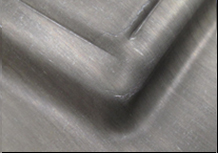
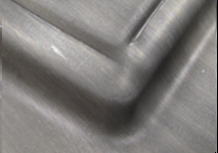
Significantly improved formability compared to AZ31B alloy Greatly enhanced room temperature LDH (Limit Dome Height)in Erichsen test results. Test results for the parts below show that the forming temperature greatly improved from above 250°C to the 150°C level.
-
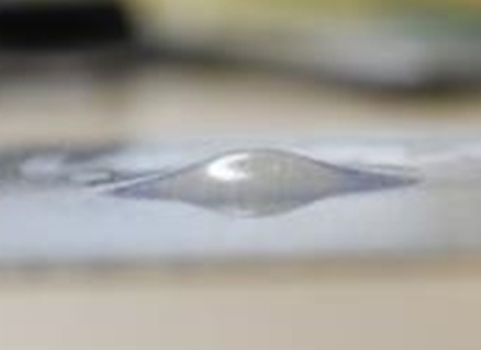
AZ31B
-

New alloy (E-form Plus)
As a result of part forming test, lowest forming temperature reduced from 250 to 150 ℃
| Alloy | Room Temp. | 100 ℃ | 150 ℃ | 200 ℃ |
| AZ31B | 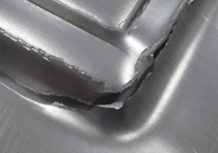 |
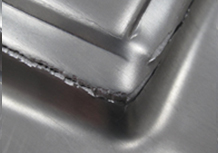 |
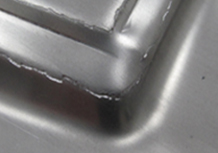 |
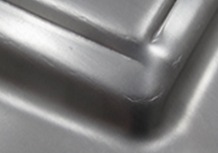 |
| E-form Plus | 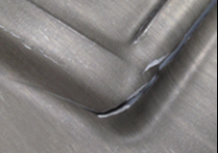 |
 |
 |
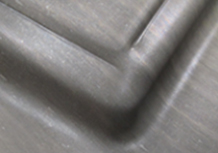 |
| Remark | Cracks on both | Rare cracks on E-form Plus | No crack on E-form Plus | No crack on E-form Plus |